Sunday, November 3, 2013

Quickselect FTW!

More than a year ago, I answered a question on Stack Overflow about the Quickselect algorithm, which takes some unsorted data and finds the k-th smallest value (that is, the value that would be in position k if you were to sort the data). The person asking the question had seen multiple technical descriptions of the algorithm, but was looking for a simplified explanation that was not expressed as computer code. I tried to illustrate the algorithm in story form, and others seemed to like my story. The surprising part to me has been that votes continue to trickle in even today, and that this deliberately silly story is now my most upvoted answer. I suppose there's a lesson in there somewhere...

You walk into a gymnasium containing 200 children. It is September 8th, so you have a burning desire to find the 98th shortest child. You know that you could line them all up from shortest to tallest, but that would take forever. “I know”, you think, “I could use QUICKSELECT!”

You walk out into the crowd, close your eyes, stick out your finger, and spin around three times. When you open your eyes, you are pointing directly at one of the children, Peter Pivot. You say, “Quickly! Everybody shorter than Peter, come stand over here. And everybody taller than Peter, go stand over there. If you're the same height as Peter, you can go into either group.”

The children shuffle around, and soon they are standing in the two groups. You count and find 120 children in the shorter group, and 79 children in the taller group. You know the 98th shortest child must be in the shorter group, so you tell Peter and the 79 taller children to sit in the bleachers.

You again close your eyes, stick out your finger, and spin around three times. When you open your eyes, you are pointing directly at Peter's sister, Paula Pivot. You say, “Quickly! Those of you who are still standing. If you're shorter than Paula, come stand over here. If you're taller than Paula, go stand over there. If you're the same height, you can go into either group.”

The children shuffle around, and soon they are standing in the two groups. You count and find 59 children in the shorter group, and 60 children in the taller group. You know the 98th shortest child must be in the taller group, so you tell Paula and the 59 shorter children to sit in the bleachers.

You again close your eyes, stick out your finger, and spin around three times. When you open your eyes, you are pointing directly at Paula's cousin, Prudence Pivot. You say, “Quickly! Those of you who are still standing. If you're shorter than Prudence, come stand over here. If you're taller than Prudence, go stand over there. If you're the same height, you can go into either group.”

The children shuffle around, and soon they are standing in the two groups. You count and find 37 children in the shorter group, and 22 children in the taller group. You know that Paula and 59 other shorter children are sitting on the bleachers. Along with the 37 shorter children still standing, you know that a total of 97 children are shorter than Prudence. Therefore, Prudence is the 98th shortest child!

Quickselect FTW!

Sunday, November 6, 2011

On the Dangers of Giving Games as Wedding Presents
or
Well, it seemed like a good idea at the time...

[This is a letter I included with a recent wedding present.]

Dear Ben and Sarah,

Well, it seemed like a good idea at the time…

I think you’ll enjoy this game, Thunderstone. I’ve been playing it a lot with my son. Like Race for the Galaxy, this one works very well with two players, but can also handle more players. (Predictably, with more players, it becomes very chaotic, especially when thieves are in play…) I’m so certain you’ll enjoy it that I also got you the first expansion, Wrath of the Elements.

You might notice that this box is the Wrath of the Elements box. See, the first Thunderstone comes with a huge box, with lots of wasted space. That box is twice as big as this one, and only comes with about half the cards you see before you. Knowing that dealing with the larger box would be difficult for you, I’ve combined all the cards for both the main game and the expansion into this one box. (By the way, if you end up liking the game, this box will also easily hold the cards for the second expansion, Doomgate Legion.)

There was just one eensy teensy flaw with my plan. A minor thing really, hardly worth mentioning.

The original rulebook was too big for this box.

I considered several options: Just leave out the rulebook and point you to the online rules. Stick the rulebook in a separate, sturdy envelope, which is guaranteed to get lost in about 13.8 nanoseconds. Fold the rulebook in half and jam it in the box. Then I found the perfect solution. A post on BoardGameGeek described trimming the top and bottom off the rulebook—which is all wasted space anyway—with a paper cutter.

Fun With Words Did you know that a mangle was a British machine used in the 1800’s to press water out of clothes? It’s called a wringer in the US. A probably apocryphal story asserts that the word mangle came into the English language to describe the damage done to clothes by this machine, but I think the causal chain is more likely to run in the other direction, with the machine being named after the word.

Umm, where was I? Oh yes, paper cutter.

Anyway, so I bring the rulebook into school and take it over to the room with the paper cutter. I line it up carefully, and pull down the chopper…which cuts about an inch into the rulebook and sticks. I push down a little harder…and the entire back of the paper cutter lifts off the table, the chopper twists the rulebook and pulls it partway off the bed and…

Hey, have you ever had a jam in a paper shredder? And cleared it by pulling half shredded paper back out the top of the machine. The papers come out looking pristine partway down the page, and then at a certain line of demarcation (you know, that line really ought to have a cool name, like the Maginot Line or the Mendoza Line), the rest comes out drooping in sad, wrinkled tatters. What’s the word? Oh yeah, mangled. Why do I bring that up? No reason, really.

Hmm, where was I? Right, paper cutter!

So I lift up the chopper and pull the rulebook out and…let’s just say it’s not looking too good. I flip it over—the rulebook, not the paper cutter, although that might have worked better—and try again on the other side. Let’s just say that that side left me longing for the Golden Age epitomized by the results of the first side. A few more minutes, and a few muttered imprecations later, and…

You know, my wife use to do scrapbooking, and they sell these funny little scissors that are designed to make an artistic ragged edge. Expensive little buggers. If only I had known, I could have saved her a lot of money.

So…Thunderstone! Great game! I think you’re going to like it. [a few personal comments deleted]

Congratulations!

Chris

Sunday, July 18, 2010

Eating My Way Across Oahu

See also Eating My Way Across Kauai

New for Lost fans: see extra links at the end of the post

We had fewer days on Oahu than Kauai, and part of that time was spent visiting family, so we had a lot fewer meals out on Oahu. But, on our last full day, we went on the Hole-In-The-Wall food tour of Honolulu with Hawaii Food Tours. I've been on several really good food tours around New York, but this blew them all away. I highly recommend taking the tour if you ever get the chance.

Also, the title above is misleading, because all but one of the places reviewed below were in Honolulu.

Mochi

As a kid, one of my favorite treats was when my father picked up mochi from Fugetsu-Do in the Little Tokyo area of Los Angeles. Unfortunately, New York offers nothing comparable. (I've found several places that offer various kinds of manju, but not the kind I grew up with.)

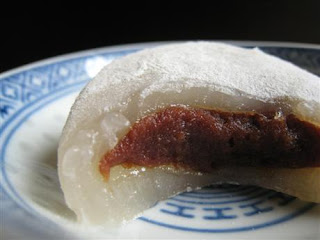
Mochi (photo by Jake Battrain)What is mochi? The kind I'm talking about is a sweet, sticky, soft, smooth rice dough, usually wrapped around a sweet red or white bean filling.

In planning our trip, I found several mochi stores in Honolulu that I knew we had to try.

Mikawaya Confectionary (inside the Shirokaya department store in Ala Moana Center): We bought four pieces and split them. The hits were orange gyohi (an unfilled orange-flavored piece that tasted a bit like a creamsicle), and taro gyohi (a purple piece with taro-flavoring in the outer dough).

Orange Gyohi (photo by Steph L.)Taro Gyohi (photo by Steph L.)

Fujiya Limited (hard to spot store on Waikamilo Road): The specialty here is fruit mochi. I was expecting some kind of fruit paste, but no, it's whole pieces of fruit wrapped inside the dough along with a little bit of bean paste. We had strawberry, blueberry, and raspberry. (I also snuck in a tsumami, which was the closest I've had to the ones I grew up with, but softer.)

Nisshodo Candy Store: The hardest of the three to find, it's literally in a warehouse behind a strip mall. Unfortunately, it was by far the worst of the three, so don't bother. My beloved white bean filling was particularly bad.

Other Sweets

I usually tend more to the savory side, but the rest of my family shares a profound sweet tooth. Hence, many of our stops involved sweets, even beyond the mochi above.

Coco Puffs (photo by )Liliha Bakery (N Kuakini St, just a little off Liliha St): Two words‒coco puffs. They sell over 5000 of these puppies a day. Basically an oversize cream puff with a creamy chocolate filling and a cap of chantilly frosting. How good are they? We went to the bakery four times, including three times in less than 24 hours! Interesting tidbit: The tiny little diner attached to this bakery is where they shot the scene in Lost where Kate visited her mother.

Malasada (photo by Lina O.)Leonard's Bakery (Kapahalu and Charles): It's all about the malasadas (Portuguese doughnuts). Fried dough, more bread-like than ordinary doughnuts, with hints of Portuguese sweet bread. Always served warm. Covered in your choice of several different powders (I took the classic sugar, but wish I had tried the li hing). Available with several different fillings (I chose haupia), or without. If you're into sweet fried dough‒you know who you are!‒this is probably a must try. I'm not, so I thought it was merely good. However, more people on our food tour picked this as their favorite stop than any other single place. Given the quality of the other places we stopped, Leonard's must be doing something right.

Coconut tarts (photo by Mark G.)Rainbow Tea Stop (Maunakea Marketplace): Very good coconut tarts, but then we tried their banana lumpia. Bananas fried in lumpia wrappers, with a carmelized coating. Out of this world. And I don't even like bananas!

While I'm talking about sweets, I should say a few words about haupia, a kind of coconut pudding. Imagine coconut-milk jello not quite as firm as finger jello and you'll be on the right track. Haupia is everywhere in Hawaii, either by itself or as a filling for other desserts, such as malasadas from Leonards or the amazing vanilla haupia pie at the Snack Shack on Kauai. If you're willing to use canned coconut milk, it's very easy to make at home. Whisk 3 cups canned coconut milk with 5 tablespoons sugar and 5 tablespoons cornstarch. Keep whisking over heat until bubbly. Spread into a pan, and refrigerate until firm. Cut into squares to serve. (Some people substitute water or milk for up to half of the coconut milk.)

Manapua

The name “manapua” literally translates to “flower power”, which makes no sense because it was a corruption of the longer phrase “mea ono pua'a” (roughly, pork pastry).

Manapua is the Hawaiian version of a Chinese bao, with the bun made out of a dough similar to Portuguese sweet bread. The buns can be baked or steamed, and the fillings can be savory or sweet, with char siu (Chinese roast pork) being the most popular. Manapua are so popular on Hawaii that they used to be sold door-to-door by the “manapua man” (Hawaii's version of the Good Humor Man). These days the manapua man sells out of a truck.

Char Siu Manapua (photo by Chelsey C.)Royal Kitchen (on the pedestrian part of River Street just off N Kukui Street): If I could transport one shop from Hawaii to my neighborhood, this would be it. I could eat a couple of these EVERY SINGLE DAY for breakfast. I loved the cha siu manapua, and the lup chong manapua was almost as good. I probably wouldn't bother with the curry chicken manapua again, but I'd still like to try the kalua pork and the Portuguese sausage. The sweet lovers in my family also enjoyed the coconut manapua and the black sugar manapua. (Another Lost sighting: the pedestrian bridge by Royal Kitchen is where they filmed Sun paying off Jin's mother.)

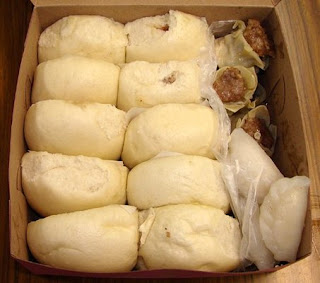
Manapua and pork hash (photo by Malia H.)Libby Manapua (corner of Kalihi and Kalani): After enjoying Royal Kitchen so much, we stopped here on our way to the airport to pick up lunch. My internet research had turned up Libby Manapua as a strong contender for best manapua on the island. My verdict was that Royal Kitchen is better. The buns at Libby were bigger than Royal Kitchen's, but with too little filling for all that bread. Also, Libby offered a much smaller selection of fillings. On the other hand, the pork hash at Libby was fantastic. You can see these little pork-filled dumplings in the upper right corner of the box.

Sing Cheong Yuan Bakery (Maunakea Street): Not really manapua, but close enough that I'll mention it here. We never went into the store, but we were able to sample their ma tai su, a flaky bun filled with an intensely flavorful pork/shrimp mixture. Heavenly!

Noodles

Ramen Nakamura (on Kalakaua Avenue in Waikiki): After binging on Hamura Saimin on Kauai, I wanted to compare it to the “real thing”. Ramen Nakamura was very, very good‒I'd happily eat there again anytime‒but a notch below Hamura. To me, the biggest difference was in the noodles themselves, but I also had a slight preference for Hamura's broth. To be fair, Ramen Nakamura offers several different broths; I had the miso, but maybe the shio or shoyu broth would have fared better. Someone whose opinion I trust later told me that Ramen Nakamura has the best ramen in the city, and I believe it. Any negativity here should be read as praise for Hamura rather than a knock against Ramen Nakamura.

Ying Leong Look Funn Factory (Keekaulike Street): We were lucky enough to tour this tiny factory, where they still make look funn rice noodles by hand. First, they ladle the soupy noodle batter onto aluminum sheet pans, then steam them in the silver steamers shown in back. (photo by Maria Ebling) When the pans come out of the steamer, they are stacked in front of fans to cool. (photo by Maria Ebling) The noodles are carefully peeled out of the pan... (photo by Maria Ebling) ...and folded into stacks that look like giant calamari. Most of the noodles shown in these pictures are plain, but you can see small chunks in the batter in the first picture. These chunks are green onion and either char siu or shrimp. Below, you can see the finished product, sliced and drizzled with a little bit of soy sauce. Delicious! Look Funn (photo by Joshua C.)

Polynesian Cultural Center Luau

We spent a full day at the Polynesian Cultural Center. It's fun and worth the trip, although if we do it again we would skip the tour guide. But forget all the cultural stuff‒I'm here to talk about the food!

First, I have to get something off my chest: Dear PCC, The shave ice you sell in the park really should be shaved, not crushed!

Ok, I feel much better now.

The shave ice may have been disappointing, but their luau more than made up for it. Everything I tried was at least good, with many dishes reaching into outstanding territory, including

  • fabulous kalua pig, probably the second best I had on the trip
  • outstanding taro rolls (purple dinner rolls made with taro flour)
  • the best poke I had on the trip (poke is marinated chunks of raw ahi, although I found out later that PCC uses a Tahitian recipe rather than Hawaiian)
  • a wonderful sweet potato salad made from purple Okinawan sweet potatoes
  • fabulous pipikaula (similar to beef jerky, but softer)
  • the best haupia I had on the trip

Of course, they also had luau staples such as poi, lomilomi salmon, chicken long rice, chicken teriyaki, and fresh pineapple. All these were good, but not as memorable as the above dishes.

Pineapple with li hing powder (photo by millietastic)Speaking of fresh pineapple... At the family luau we went to for my cousin's first birthday, I gorged myself on fresh pineapple sprinkled with li hing powder.

A few years ago, I tried li hing mui, the king of the Hawaiian snack genre known as “crack seed”. Li hing mui is a salty dried plum covered with a bright red powder. The combination is salty, sweet, sour, stains your fingers red, and does funny things to your mouth. I have to admit I didn't like it. I think I even used the word “disgusting”.

But what I've now learned is that you can get the powder without the plum. I had it several times this trip sprinkled on fresh pineapple, which takes an already excellent treat up to the next level. I've heard that the powder is also good sprinkled on other kinds of fruit, on popcorn, even on ice cream. We brought a bag home that I look forward to experimenting with.

New for Lost Fans

I found a website (Lost Virtual Tour) that includes some great pictures of the places I mentioned, showing what they look like in the show and in real life.

To my surprise, this site also shows the pub where we went to our family luau.

Friday, July 16, 2010

Eating My Way Across Kauai

See also Eating My Way Across Oahu

I love to eat, so I'm going to temporarily hijack this blog with some dining recommendations from our recent vacation in Hawaii.

We just got back from almost two weeks in Hawaii. My favorite part of the trip was eating my way across Kauai and Oahu. In planning for the trip, I got a lot of good tips from food blogs and other internet reviews, so I'm going to pay it forward by reporting on our dining hits and misses. This post will cover Kauai, and the next post will cover Oahu.

Be aware that many of these places take cash only.

Must Try

Saimin Special (Photo by Christina C.)Hamura Saimin Stand (Lihue, close to the airport): This place is a dive...and I mean that in the best possible way. It's old, run-down, hard-to-find, and tiny, so you'll probably have to wait for a few minutes. But the food is amazing, not to mention cheap and plentiful! I'm a huge fan of ramen (the real stuff, not the dried packages you find in the grocery store) and Hamura serves some of the best you'll find this side of Japan. The “special” (shown to the right) is a huge bowl filled with wonderful noodles and broth, and then topped with char siu (roast pork), won tons, fish cake, ham, green onions, cabbage, and a hard-boiled egg. The bbq sticks (beef or chicken), crispy wontons, and lilikoi (passion fruit) chiffon pie are also excellent, but be aware that they run out of the pie. Seating is at a single zig-zag counter, so be prepared to chat with your neightbors.

Highly Recommended

Hanalei Dolphin (photo by Cheri A G.)Hanalei Dolphin Restaurant (Hanalei, on the right as you first drive into town): The best “fancy” meal we had on the trip. I had the shutome (broadbill swordfish) and my wife had the walu (Hawaiian butter fish). The shutome was among the best fish I've had in my life, and the walu was almost as good. Both were simply grilled, and then served with a slice of lemon and some drawn butter. The butter, in particular, was a revelation for me. Sure, you often see it with lobster and the like, but usually not with fish. After experiencing how much it enhanced the fish here, I'll have to ask for it at other places.

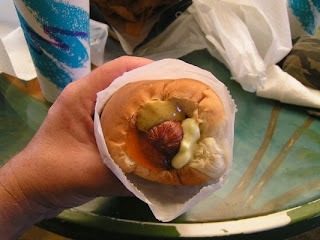
Puka Dog (photo by Diana H.)Puka Dog (Poipu, inside the Poipu Shopping Village): My son LOVED these, declaring them almost as good as my father's sweet-and-sour chicken wings, which is his high-water mark for non-dessert foods. They take a huge unsliced bun, and stick it onto a big spike, which both makes a hole for the dog and toasts the inside of the bun. They then put some toppings in the hole, fill the bun with a polish sausage, and add some more toppings to the tip of the sausage sticking out of the hole. Okay, the hole thing is a gimmick, but where they really shine is the toppings‒six different fruit relishes including mango, pineapple, papaya, banana, star fruit, and coconut (mango and pineapple are probably the best). They also include a mayonnaise-like “garlic lemon secret sauce”.

Pat's Taqueria (photo by Mark W.)Pat's Taqueria (aka Pat's Taco Wagon) (Hanalei, by the base of the pier): On the mainland, lunch wagons are usually nothing special, but Hawaii has a tradition of great food served out of trucks. Pat's Taco Wagon is an excellent example. My first visit, I had the kalua pork burrito, which was very good. My second visit, I had the carne asada taco, which was mind-blowing. Both were kind of drippy, so be sure to lean over when you eat them.

Vanilla haupia pie (photo by alli t.)Village Snack & Bakery (aka The Snack Shack) (Hanalei, in the back of the Ching Young Village Shopping Center): My favorite dessert on the island, vanilla haupia pie. Mmmm! If you get there early in the morning, you may also be lucky enough to get their fried mochi (three balls of mochi with a sugary coating on a stick). Their loco moco (a Hawaiian tradition with two scoops of rice, a hamburger steak, and two fried eggs, covered with brown gravy) and teriyaki beef sandwich were also outstanding, but the pancakes and apple cobbler were only so-so.

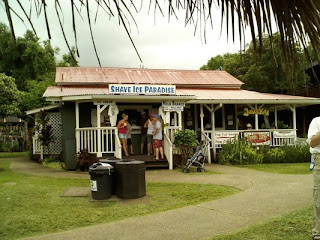
Shave Ice Paradise (photo by beno h.)Shave Ice Paradise (Hanalei, across the street from the Ching Young Village Shopping Center): Shave ice is everywhere in Hawaii. Think giant snow cone, but made with shaved ice instead of crushed ice. The difference in texture is substantial, smooth instead of pebbly. You have a choice of many different syrups, and can add on ice cream underneath or sweetened condensed milk on top. The ice cream at the bottom didn't do much for me because you end up eating the top half of the ice without it, but the sweetened condensed milk on top (sometimes called a sno cap) is fantastic, changing what can sometimes be sickly sweet to sweet and creamy. Shave ice stands are very common, and there's not necessarily a lot of difference between them, but this one was the best we tried.

Hanalei Taro & Juice Company (photo by Janet D.)Hanalei Taro & Juice Company (Hanalei, in front of Kayak Kauai): Another lunch wagon. Plate lunches are a Hawaiian tradition with two scoops of rice, macaroni salad, and some kind of meat. I had the kalua pork plate lunch, which turned out to be the best kalua pork I tried on the island. The plate lunch also came with a little slice of their mochi cake, which is very good. They are famous for their smoothies, with use a taro base in addition to various combinations of fruit. My smoothie was good, but nothing special. The downside is that it's hard to find them open! I think they move around, but I didn't know where to look other than their main location.

Recommended

Kountry Kitchen (Kapaa): Gigantic macadamia nut pancakes, which were fantastic with coconut syrup. I had the special loco moco, which had kalua pork instead of the usual hamburger steak, and it was very good also.

Bubba Burgers (Hanalei, across the street from the Ching Young Village Shopping Center): Try the teriyaki burger with pineapple. These are fast food burgers rather than restaurant burgers, but still good.

Lappert's Hawaii (Princeville, in the Princeville Center): Good ice cream with unusual flavors. I'd say good, but not great. Both Kilauea Video and Ice Cream (in Kilauea) and Pink's Creamery (in Hanalei) sounded better to me, but we didn't get to try those.

Banana Joe's (Kilauea, just off the highway): I didn't go, but my family loved their frostees. They also had some great fresh fruit, including lychees and “apple bananas”.

Tip Top Motel Cafe & Bakery (Lihue): Very busy, but incredibly fast service. The pancakes were good, but not as good as Kountry Kitchen's. I enjoyed the bento breakfast, which included teriyaki beef, chicken wings, Goteborg sausage, rice and macaroni salad.

Mediterranean Gourmet (Hanalei, way past the main drag, almost to Haena, at the Hanalei Colony Resort): We ate two lunches there, with good gyros, falafels, and chicken kebabs. We also went to their once-a-week luau since we were staying at the resort. The food at the luau was only so-so, but the entertainment was fun, if much lower key than many of the fancier tourist luaus.

Not Recommended

Bar Acuda (Hanalei): We were disappointed in this highly recommended tapas bar. The food we had there was good, some of it excellent. The problem is that their menu is just too limited, with only about a dozen choices for tapas. After running through everything we wanted to try out of their tapas offerings, we proceeded down the street to Bubba Burgers because the kids were still hungry.

Hanalei Gourmet (Hanalei): Okay, but nothing special.

Bouchons Hanalei (Hanalei): Nice atmosphere, but mediocre food. I did not try their sushi, so maybe that's better.

Monday, November 23, 2009

Round-Robin Tournament Scheduling

For the last several years, I've held an in-class tournament on the last class day before Thanksgiving. Everybody's mind is elsewhere anyway, so the positive vibes generated by an hour spent hootin' and hollerin' are far more valuable than class content that would be forgotten long before the turkey made it into the oven.

Tomorrow's the big day, so I've spent part of today working out the tournament schedule. As usually seems to be the case, I have a different number of teams this year from past years, so I had to make a new schedule from scratch. I keep forgetting how I did it last time, but I always seem to converge back on the same technique. I finally decided to write down the technique so I can just look it up next year. Also, I'm hoping somebody can tell me what this technique is called, since it can't possibly be original.

Unless I have too many teams, I like to run a round-robin tournament, where everybody plays everybody else. There's a well-known algorithm for scheduling such a tournament by hand. I'll illustrate this algorithm with 6 teams, numbered 0–5. Start by writing the teams down in two rows, as follows:

   0 1 2
   5 4 3
The columns say which teams play each other. In this case, team 0 plays team 5, team 1 plays team 4, and team 2 plays team 3.

Now, leave team 0 in place, but rotate teams 1–5 one position clockwise.

   0 5 1
   4 3 2
In this round, team 0 plays team 4, team 5 plays team 3, and team 1 plays team 2. This process continues for three more rounds:
   0 4 5
   3 2 1

   0 3 4
   2 1 5

   0 2 3
   1 5 4
For an even number of teams, this technique generates a schedule with N−1 rounds, and N/2 games per round. For an odd number of teams, you add an extra dummy team, yielding a schedule with N rounds and (N−1)/2 games per round. In each round, the team scheduled against the dummy gets a bye.

Many games have a slight asymmetry, such as a homefield advantage or a first-move advantage. For my game, the “red” team has a very small advantage over the “blue” team. In tournaments for such games, it is important to balance the number of “home” games and “away” games played by each team. In the above algorithm, this is accomplished by making the top row the home team in odd-numbered rounds and the bottom row the home team in even-numbered rounds. (Note that, when N is even, half the teams will get one extra home game.)

Okay, so the above technique is easy, but it has a major drawback for my purposes, at least when N is odd. Because the tournament must be completed by the end of the class period, I need to be ready to drop games from the schedule if it looks like we're running long. The easiest way to accomplish this is to drop an entire round. But when N is odd, one team has a bye, which means that that team will end up playing a different number of games from everybody else, which in turn can make it difficult to determine the winner of the tournament.

To avoid this problem, I use the following technique. I organize the schedule in N/2 rounds, rounded down if N is odd. In each round (except possibly the last), every team plays twice: one home game and one away game. The rule is that, in round R, team X plays at home against team (X+R) mod N, and away against team (X−R) mod N. (If you don't remember how mod works, it simply means that the team numbers wrap around.) For example, here is a schedule for 7 teams, numbered 0–6.

   Round 1: 0-1 1-2 2-3 3-4 4-5 5-6 6-0

   Round 2: 0-2 1-3 2-4 3-5 4-6 5-0 6-1

   Round 3: 0-3 1-4 2-5 3-6 4-0 5-1 6-2
Each game is listed as HOME TEAM–AWAY TEAM.

If N is even, then the last round is treated specially. As described so far, the last round in an 8-team tournament would look like

   Round 4: 0-4 1-5 2-6 3-7 4-0 5-1 6-2 7-3
This involves repeat games, such as 0-4 and 4-0. To prevent such repeats, we chop off the second half of the last round when N is even.

Again, the advantage of this scheduling algorithm is that I can delete a round on the fly without causing an imbalance in the number of games that each team plays. Deleting a round also maintains the balance between home games and away games for each team, although that's a lesser concern.

Thursday, October 22, 2009

Binomial queues as a nested type

Warning: this is probably only of interest to functional programmers.

Maciej Kotowicz recently asked on the Haskell Cafe mailing list about implementing binomial queues (also known as binomial heaps) using fancy type machinery so that the type-checker can enforce the shape invariants of the data structure. This reminded me of a discussion I had with some colleagues in the summer of 1998 about using nested types to enforce these kinds of invariants. A little digging around in mail archives yielded this email, presented here with some light formatting and a few fixed typos.

I've been playing with binomial queues as a nested type, and I think you'll find the end result interesting.

REVIEW

Let me first quickly review the usual implementation of binomial queues. Recall that a binomial tree has the shape

data Tree a = Node a [Tree a]
A binomial tree of rank k has k children, of ranks k-1 .. 0 (stored in the list in decreasing order of rank). Note that we can combine two heap-ordered binomial trees of rank k to get a heap-ordered binomial tree of rank (k+1) as follows:
combine a@(Node x xs) b@(Node y ys)
   | x <= y    = Node x (b : xs)
   | otherwise = Node y (a : ys)
Now a binomial queue is a list of heap-ordered binomial trees of increasing height (but not necessarily of consecutive ranks). We'll represent the ranks of those trees that are present by their position in the tree. Thus, some ranks will be empty. This could be implemented as
type Binom a = [Maybe (Tree a)]
or somewhat more efficiently as
data Binom a = Nil
             | Zero (Binom a)
             | One (Tree a) (Binom a)
or better still by unboxing the Tree in the One constructor
data Binom a = Nil
             | Zero (Binom a)
             | One a [Tree a] (Binom a)
I won't go over all the operations -- they are amply covered elsewhere. I'll just describe two functions. The first, add, takes a tree and a list (where the tree has the same rank as the first position in the list), and returns a new list. It works basically like the increment function on binary numbers.
add :: Ord a => a -> [Tree a] -> Binom a -> Binom a
add x xs Nil = One x xs Nil
add x xs (Zero h) = One x xs h
add x xs (One y ys h)
  | x <= y    = Zero (add x (Node y ys : xs) h)
  | otherwise = Zero (add y (Node x xs : ys) h)
The merge function is similar and works basically like the addition function on binary numbers.

Finally, the getMin function returns the minimum element of a queue paired with the queue without that element. The helper function getMin_ returns a triple of the minimum element in some suffix of the queue, the list of children associated with that minimum element, and the suffix without that element.

getMin_ :: Ord a => Binom a -> (a, [Tree a], Binom a)
getMin_ (Zero h) = case getMin_ h of
                     (y,ys,h') -> (y,ys,Zero h')
getMin_ (One x xs Nil) = (x,xs,Nil)
getMin_ (One x xs h) = case getMin_ h of
                         (y,ys,h') | x <= y    -> (x,xs,Zero h)
                                   | otherwise -> (y,ys,One x xs h')

getMin :: Ord a => Binom a -> (a, Binom a)
getMin h = let (x,xs,h') = getMin_ h
           in (x,merge (list2binom xs Nil) h')

list2binom [] h = h
list2binom (Node x xs : ys) h = list2binom ys (One x xs h)
Note that when getMin receives a list of children, it converts them to a valid binomial queue by reversing the list (and changing each pair of a Node constructor and a (:) constructor to a One constructor).

NESTED REPRESENTATION -- FIRST ATTEMPT

By following the same approach we have been using to design nested datatypes, we get the following representation of binomial queues.

data Binom_ a b = Nil
                | Zero (Binom_ a (Trees a b))
                | One a b (Binom_ a (Trees a b))

type Trees a b = (a, b, b)

type Binom a = Binom_ a ()
Here the list of children
  (Node x3 xs3 : Node x2 xs2 : Node x1 xs1 : Node x0 xs0 : [])
is being represented by the nested triples
  (xs3,xs3', (x2,xs2', (x1,xs1', (x0,xs0', ()))))
(where xsN' is the appropriate conversion of xsN).

All the functions are perfectly straightforward, except for getMin and getMin_ which must incrementally build up the reversing function to convert

  (xs3,xs3', (x2,xs2', (x1,xs1', (x0,xs0', ()))))
to
  One x0 xs0' (One x1 xs1' (One x2 xs2' (One x3 xs3' Nil)))
As a result of building up this reverse function incrementally, this implementation ends up being roughly 10% slower than the original.

INTERLUDE ON REVERSING LISTS

Suppose we want to support the following ADT. We want sequences with three operations:
empty :: ReversableSeq a
cons  :: a -> ReversableSeq a -> ReversableSeq a
rev   :: ReversableSeq a -> [a]
with the obvious semantics. cons must take O(1) time, but rev may take O(n) time. A list is a reasonable implementation with
type ReversableSeq a = [a]
empty = []
cons = (:)
rev = reverse
but, if you think about it, there's a fair amount of interpretive overhead in the pattern matching that reverse performs at every step. Way back in 1985, John Hughes came up with a representation that avoids this overhead:
type ReversableSeq a = [a] -> [a]
empty = id
cons x xs = xs . (x:)
rev xs = xs []
The result of cons 1 (cons 2 (cons 3 empty)) is
id . (3:) . (2:) . (1:)
which, when applied to [] by the rev function, yields [3,2,1]. One way to think of this representation is as lists with "holes" at the ends. The cons operation fills in this hole with an element and another hole, and the rev operation fills in the hole with []. (This is quite similar to difference lists in logic programming...)

Applying this trick to the regular representation of binomial queues yields

data Binom a = Nil
             | Zero (Binom a)
             | One a (Binom a -> Binom a) (Binom a)
which turns out to be about 10% faster than the original representation.

NESTED REPRESENTATION -- SECOND ATTEMPT

Ok, let's try to make a nested datatype out of this. Conceptually, the nesting should keep track of our position in the queue so that we know what rank the current tree has and can't possibly mix up trees of different ranks. We hypothesize some Base type for the beginning of the list, and some type transformer Succ that modifies the type as we move down the queue.

type Base = ???
type Succ b = ???  -- this might need to be Succ a b

type Binom a = Binom_ a Base

data Binom_ a b = Nil
                | Zero (Binom_ a (Succ b))
                | One a (Binom_ a ??? -> Binom_ a ???) (Binom_ a (Succ b))
Now, what should the missing types in the One constructor be? Well, the function (Binom_ a ??? -> Binom_ a ???) represents the children of the current node. If this node is of rank k, then these children are of ranks 0 .. k-1. The function (Binom_ a ??? -> Binom_ a ???) takes a queue starting at rank k and adds the children to the front of it, yielding a queue starting at rank 0. So the ???'s can be filled in as
                | One a (Binom_ a b -> Binom_ a Base) (Binom_ a (Succ b))
or just
                | One a (Binom_ a b -> Binom a) (Binom_ a (Succ b))
Now, what should the types Base and Succ be? It doesn't matter because we never construct data of those types, we simply use the types to discriminate between positions in the queue. So we can define Base and Succ as
type Base = Void
newtype Succ b = S Void
I think this is a very interesting type for several reasons:
  • It includes an arrow type, which we haven't seen much.
  • The RHS of the datatype definition (in fact, just the One constructor) has occurrences of Binom_ at no fewer than three different types
    Binom_ a b
    Binom_ a Base
    Binom_ a (Succ b)
    
    I've seen two before, but not three.
  • It includes types which are never used, but are merely there to capture certain invariants (in this case, that trees of different ranks should never be confused). [2009 Comment: Today, these are called phantom types.] In some ways this might make this type less interesting, but an interesting consequence is that the code satisifes a certain "type erasure" property: if you erase the types from all the functions, you get code for the optimized regular representation.
Because of this "type erasure" property, you might expect it to be just as fast as the optimized regular representation, but in fact it is roughly 10% slower -- or roughly as fast as the original regular representation. This is because the extra types hinder a certain optimization that the programmer might make (and which I did make in the optimized regular representation).

Recall the type of the getMin_ function from the original regular representation, and the way it was used by getMin.

getMin_ :: Ord a => Binom a -> (a, [Tree a], Binom a)

getMin :: Ord a => Binom a -> (a, Binom a)
getMin h = let (x,xs,h') = getMin_ h
           in (x,merge (list2binom xs Nil) h')
For the optimized regular representation, this becomes
getMin_ :: Ord a => Binom a -> (a, Binom a -> Binom a, Binom a)

getMin :: Ord a => Binom a -> (a, Binom a)
getMin h = let (x,xs,h') = getMin_ h
           in (x,merge (xs Nil) h')
Now, consider the optimized nested representation. We can't just write
getMin_ :: Ord a => Binom_ a b -> (a, Binom_ a b -> Binom a, Binom_ a b)
because we don't know the rank of the tree that the second component of the triple came from. (Note that if we had existential types, we could write
getMin_ :: Ord a => Binom_ a b -> 
                    (a, exists c. Binom_ a c -> Binom a, Binom_ a b)

getMin :: Ord a => Binom a -> (a, Binom a)
getMin h = let (x,xs,h') = getMin_ h
           in (x,merge (xs Nil) h')
Some implementations do in fact support existential types, but in limited ways that would carry efficiency costs of their own...)

Instead of returning the children and then applying them to Nil at the end, we apply the children to Nil first, and then return the result, yielding the type

  
getMin_ :: Ord a => Binom_ a b -> (a, Binom a, Binom_ a b)

getMin :: Ord a => Binom a -> (a, Binom a)
getMin h = let (x,xs,h') = getMin_ h
           in (x,merge xs h')
This depends on laziness to evaluate only the children of the final minimum, and not all the children of the temporary minimums along the way. However, this does mean that we build a lot more thunks of the form (xs Nil) along the way. And building these thunks is apparently quite expensive.

2009 Addendum Ralf Hinze considers a similar representation in Section 6 of Numerical Representations as Higher-Order Nested Datatypes. Today, you would probably use fancier type machinery like dependent types or maybe GADTs, but it's still amazing how far you can get with only nested types.

Wednesday, October 1, 2008

Score one for induction!

One of my favorite textbooks on algorithms—in spite of the fact that it's twenty years old—is Udi Manber's Introduction to Algorithms: A Creative Approach. However, I have never been tempted to actually use it in class. You see, the book's greatest strength is also its greatest weakness.

Most textbooks on algorithms show you a lot of polished algorithms, but provide little or no insight on how to go about designing such algorithms. Manber's book does a very good job providing such insight, by making an analogy with inductive proofs. If you have any skill with induction, then you can use Manber's approach to help you design algorithms. (Of course, this should come as no surprise since writing an inductive proof and writing a recursive function are essentially the same activity.)

I'm sure you see the flaw here—most students are even less comfortable with induction than they are with recursion. It's like trying to help somebody learn to drive a car by making an analogy with riding a unicycle. For a certain segment of the audience, that analogy might be just what they need, but for the most of the audience, the analogy will only produce puzzled looks.

I was recently helping a student who was struggling to get a handle on recursion. He was making the common beginner mistake of trying to think about what happens during the recursive call instead of trusting that the recursive call works (sometimes called the recursive leap of faith). By sheer coincidence, I had happened to notice the day before that this student had done very well in our discrete math course the previous year. Time to give it a try...

“You know when you're writing a proof by induction and at some point you use the inductive hypothesis? That's just like a recursive call. You don't worry about what happens inside the inductive hypothesis, you just say ‘Assume that it works for N-1...’ It's the same with recursion. You just assume that the recursive call works.”

That comparison actually seemed to help. Maybe Manber was onto something after all!

Thursday, September 25, 2008

Less than vs Greater than

From math, we know that X < Y is the same as Y > X. But in programming, they're not the same.

Oh, I'm not talking about situations where X and Y have side effects that interact badly. Instead, I'm talking about situations where one may be more error prone than the other.

Although the two expressions are mathematically equivalent, they're not linguistically equivalent. One focuses attention on something being smaller, and the other focuses attention on something being bigger. For example, it is a relatively common mistake to go the wrong way when searching a binary search tree. However, almost every time I run into this error, the student has also written the comparisons backward from the direction I think of as “natural”.

Consider the following function for determining whether a given key x appears in a binary search tree t:

  function member(x,t) is
     if t = null then return false
     if t.key = x then return true
     if t.key < x then return member(x,t.left)
     if t.key > x then return member(x,t.right)
The fact that I've written this using recursion instead of iteration is irrelevant. What matters is that the third case goes left when it should go right, and vice versa for the fourth case. But looking more carefully at that third case
     if t.key < x then return member(x,t.left)
I'm not particularly surprised by the error. The comparison t.key < x focuses attention on something being smaller, and the left side of the tree is where the smaller keys go. By asking whether x is smaller than t.key, rather than whether t.key is smaller than x, I think we're much less likely to fall into this trap.

Saturday, September 13, 2008

Hey, you got your loop in my recursion!

I've written before about trying to diagnose students' broken or ineffective mental models from the mistakes they make. Here's a mistake that I see frequently from students who are not yet comfortable with recursion.

Say you wanted to write a function to calculate the sum of a list using a loop. Many students could easily write something like

   function sum(list) is
      variable total := 0
      while list /= null do
         total := total + list.item
         list := list.next
      return total
But ask them to write the sum function using recursion, and you might get something like
   function sum(list) is
      variable total := 0
      if list = null then
         return total
      else
         total := total + list.item
         return sum(list.next)
Of course, this code always returns 0. It's pretty clear that the writer had the iterative algorithm in mind, and doesn't understand that each recursive call to sum creates a new instance of the total variable.

When I watch such a student writing code like this, he often declares the variable immediately, before even beginning to think about what the recursive decomposition is going to look like, an almost spinal reflex conditioned by several semesters of writing loops. I can explain recursion until I'm hoarse and draw pictures until my hand cramps up, but I can't compete with the will-o'-the-wisp allure of that variable. Once it's there, it will almost inevitably lead the student to his doom in the bogs of iterative thinking.

One trick to help such a student is to break the cycle where it begins, by getting rid of that variable. Tell him to write the function without using any local or global variables. Or, if he really thinks he needs a variable, to declare it as a constant instead. Of course, there are times when a variable is perfectly appropriate inside a recursive function, but such examples can often be avoided until the student has a better grasp of recursion.

Thursday, July 31, 2008

In search of epiphany

I watched the movie Proof last night. I highly recommend it. It's not often that mathematicians get so much screen time.

The nature of mathematical creativity plays a large role in the movie. One comment was especially intriguing. (Minor spoiler ahead.) In describing the process of solving a particularly difficult problem, one character says, “It was like...connecting dots. Some nights I...I could connect three or four of them. And some nights they'd be really far apart. I'd have no idea how to get to the next one, if there was the next one.”

This description rings both true and false for me. The true part is I'd have no idea how to get to the next one, if there was the next one. This nicely summarizes what it's like to work on a hard problem. You don't know what to do next, and you're not sure that a solution even exists.

But the connecting dots part doesn't feel right. It makes the process sound linear, when the reality is anything but. In my experience, the really hard problems—the ones that require the most creativity—are most often solved by epiphany, by having the whole solution burst into your head, seemingly in an instant. That's when the connecting dots part happens, but it all happens at once, not a few a time.

Of course, the catch is that epiphany can't be forced. I'm reminded of the old joke about the lottery. A man prays fervently every night, “Please, Lord, let me win the lottery tomorrow.” After twenty years, a heavenly voice responds, “Would you buy a ticket already!”

No, you can't just sit around waiting for an epiphany to happen. Epiphanies are hard work! TANSTAAFL. So, how do you go about searching for epiphany? Every epiphany I've ever had has been the result of a two-pronged effort.

The first prong is building up sweat equity. I thoroughly explore the space around the problem, playing with the problem from many different angles. Of course, I'm actively trying to solve the problem during this time, because I might get lucky and stumble across a solution. But I don't worry too much if I don't seem to be getting anywhere. This part of the process is not so much about connecting the dots as about building lots and lots (and lots) of potential connections.

The second prong is staying alert. That's easy to say, but really hard to do over long periods of time. Eventually, I hope, some stray thought or some environmental trigger will start a cascade, where some subset of those potential connections will become actual connections, creating a path to the solution. Sometimes this happens when you're relaxed and your mind is drifting, such as in the shower or while driving. I remember once in grad school trying all afternoon to track down a bug. That night my wife and I went over to a friend's house for dinner. Everybody was shocked when, in the middle of beef stroganoff, I suddenly shouted out, “That's it!”

Other times the epiphany can happen while you're actively working on something else. For example, the key insight behind TradeMaximizer came while I was trying to put together a homework for my Algorithms class. I had been working off and on for weeks trying to find cycles in the trade graph. But I had set that aside and was coming up with homework problems, when I stumbled across a stray comment that talked about converting a directed graph into a bipartite graph. That sentence was enough to set off the chain reaction of connections and, within seconds, TradeMaximizer was born.

Probably the most famous story about scientific epiphany is that of Archimedes' bath. Funny story: Shortly after announcing TradeMaximizer to the math trade community on BoardGameGeek, I received a peevish email from another BoardGameGeek user who thought he also had a solution. He described how he had come to BoardGameGeek, eager to share his discovery, only to find my announcement first. He complained “Argh! Way to shout ‘Eureka!’ while Archimedes is drying himself off!” (The other solution turned out to be bogus.)

Wednesday, July 16, 2008

Games for Programmers: Black Vienna

The next in an irregular series of board game recommendations for programmers. Of course, you don't have to be a programmer to enjoy these games, but if you are a programmer, then I think there's a pretty good chance that you'll like them.

O frabjous day!

My favorite deduction game, Black Vienna, has long been out of print, but now you can give it a try online, thanks to the efforts of Greg Aleknevicus. Go check out Black Vienna Online. It's free and easy to use. The user interface isn't going to win any awards, but it gets the job done. I'm thrilled that this game can now reach a wider audience.

Most deduction games are for two players, but Black Vienna handles three to six players. Your goal is to figure out the members of the infamous “Black Vienna” gang. There are 27 suspect cards, labeled A-Z and Ö. At the beginning of the game, three of these cards are chosen randomly and set aside. Those are the members of the gang.

The remaining 24 suspect cards are dealt out evenly to the players. (With 5 players, one of the players gets only 4 cards.) These are the cards of suspects for whom you can provide alibis.

On your turn you conduct an investigation. There is a pool of available investigation cards, each showing three suspects. You choose one of the available investigation cards and place it in front of another player. That player marks the card with plastic chips, according to how many of the suspects are in her hand. For example, if I have the cards BGMTXY and somebody plays the BQT card on me, I would mark it with two chips (for the B and the T). Other players would then know that I had two of the three suspects, but not necessarily which ones.

The turn then passes to the player who was just investigated.

One nice thing about Black Vienna as a game is that every player is involved on every turn. Even if you are not actively part of the investigation, you still need to update your information with the results of the investigation, and follow any chains of deductions to their conclusions.

Example Deductions

Some deductions are obvious. For example, if I played two chips on the BQT card, and you have the Q card in your hand, then you know that I have the B and the T. Other deductions are less obvious. Here's an actual example from a recent game. Call the other players Caitlin, Monica, Drew, and Dom.

Monica played one chip on GPX, but I had the X, so I knew that she had either G or P (but not both). Similarly, she also played one chip on DHR, but I knew Dom had the R, so Monica had either D or H. Finally, she played two chips on LNV.

Drew played one chip on DVY and zero chips on FÖY, so he had either D or V. Between Drew and Monica, they had at least 4 of the 5 cards DHLNV and at least 5 of the 7 cards DGHLNPV (possibly more if Drew had any of GHLNP).

Meanwhile, I knew all but two of Caitlin's cards. The only possibilities for those last two cards were DGHLNPV. Monica and Drew together had at least 5 of those 7 cards, so Monica, Drew, and Caitlin together must have all 7.

This tells me that none of these 7 cards are in the gang, and none of these 7 cards are in Dom's hand. It also tells me that Drew does not have any of GHLNP.

Finally, I can be more specific about Caitlin's cards. One of her two cards is G or P, and the other is one of DHLNV.

Online Play

The online implementation is asynchronous. You do not need to be logged in at the same time as other players. Instead, the system emails you whenever a turn is taken with the results of the investigation. When it is your turn, you can log on and take your turn at your leisure. This means that a 45-minute face-to-face game can take days or even weeks when played online, but it also means that you can play the game with odd minutes here and there, instead of having to carve out a solid chunk of time. An additional benefit is that it is easy to play with friends in different time zones. For example, I frequently play with friends on the other side of the country.

However, the greatest benefit of the online implementation is that it does away with the greatest weakness of face-to-face play—player errors. Not errors in deductions, which would be your own fault and would only affect you, but errors in answering investigations. If a player carelessly puts out, say, one chip when he should have put out two chips, it ruins the game for everyone. Even if the player notices the error a few turns later and tries to correct it, it's far too late. By then, the other players have already updated their notes with deductions made from the faulty answer, and typically have no way of backing out of those deductions.

If you want to give Black Vienna a try, see the detailed rules of the game and the instructions for the online interface.

Addendum: I've played in several three-player games recently. It's ok with that number, but I think it's significantly better with four or five players. (I haven't tried six yet.) With three players, the deductions are less interesting, and there is a greater chance for one player to get lucky.

Tuesday, July 8, 2008

Breadth-First Numbering: An Algorithm in Pictures

I've always enjoyed the mathematical tradition of “proofs without words”, so I wanted to see if something similar could be done with an algorithm. Of course, an algorithm is typically more complicated than a mathematical identity, so it's not surprising that an algorithm typically can't be captured in a single picture. Instead, I've found the idea of a commutative diagram to be a useful pictorial shorthand, where the short way around the diagram gives a high-level view of the operation, and the long way around gives more detail. Here is an attempt to describe my breadth-first numbering algorithm from ICFP 2000 using this idea.

Wanted

Rules

Example

Wednesday, July 2, 2008

Functional Programming in...Ada?

Ada is not the first language that comes to mind when you want to do functional programming. (You in the back, stop laughing!) Why, with excellent functional programming languages like Haskell or ML easily available, would I choose to do a functional programming project in Ada? (I CAN STILL HEAR YOU LAUGHING!) Partly because we use Ada in some courses at our institution, and I wanted a library that could help in teaching recursion to novices. But, honestly, mostly I just wanted to see if it could be done.

“It's like this fellow I knew in El Paso. One day, he just took all his clothes off and jumped in a mess of cactus. I asked him that same question, ‘Why?’...He said, ‘It seemed like a good idea at the time.’”
– Steve McQueen, The Magnificent Seven

Somewhat to my surprise, functional programming actually works reasonably well in Ada. You wouldn't want to program a large system this way, but small-scale projects are quite possible, albeit much more verbose than functional programmers are used to.

Instrumenting recursive functions

My application is going to be a library for instrumenting recursive functions. I want to be able to take a recursive function and run it with different combinations of monitors. Each monitor executes a little bit of extra code every time the recursive function is called, including recursive calls. Simple examples of useful monitors include counting the number of calls, or tracking the maximum call depth, or printing trace information on every call or return. More complicated examples include adding memoization to a recursive function or automatically detecting when a function is stuck in an infinite recursion.

Ideally, the library should be easy enough for students to use, but I'll settle for it being easy enough for instructors to use.

Of course, there are many ways to design such a library. I'm going to use a design based on ideas from functional programming. The basic ideas have been folklore in the functional programming community for a long time. For example, I remember doing something similar in SML in the early '90s. Bruce McAdam wrote a nice tech report describing these techniques in great detail. The trick here is going to be figuring out how to implement this design in Ada.

(Incidentally, if anybody has a truly object-oriented approach to solving the same problem, I'd be interested in seeing it.)

Preparing the recursive function

Without some kind of support for reflection, it seems too much to hope that I'll be able to observe the recursive calls inside a recursive function. Therefore, I'm willing to require some modifications to the recursive function, as long as those modifications are fairly straightforward. However, I should only need to modify the function once, rather than every time I run it with a different monitor.

Stealing an idea from functional programming called the Y combinator, I'll modify each recursive function to take an extra argument that is itself a function (or, more specifically, a pointer to a function). The recursive function will call this passed-in function wherever it would normally call itself. The passed-in function will eventually call the recursive function, but may run some other code first.

Here's an example using the ever popular Fibonacci function. The original recursive function might be written

 function Fib(X : Integer) return integer is
 begin
   if X <= 1 then
     return 1;
   else
     return Fib(X-1) + Fib(X-2);
   end if;
 end Fib;
Adding the extra argument and replacing the recursive calls with calls to the passed-in function yields
 function Fib(Rec : access function(X : Integer)
                    return Integer;
              X : Integer) return integer is
 begin
   if X <= 1 then
     return 1;
   else
     return Rec(X-1) + Rec(X-2);
   end if;
 end Fib;
where the changes are shown in red. Note that access function(X : Integer) return Integer is the type of a pointer to a function that takes an integer and returns an integer. In the rest of this post, I'll assume that the functions being instrumented always take an integer and return an integer. If I can get this to work at all, then generalizing this to arbitrary argument and return types will be trivial using Ada's notion of generics.

Running the recursive function

Now, to simply run this function recursively without attaching a monitor, I'll call it with Run, which is responsible for “tying the knot” by somehow making the function call itself. The Run function is written

 function Run(Fun : ...type to be filled in 
                       later...
              X : Integer) return Integer is
   function Rec(X : Integer) return Integer is
   begin
     Fun(Rec'Access, X);
   end Rec;
 begin
   return Rec(X);
 end Run;
Here, Fun is a function like the modified Fib above. Run defines a local helper functon, Rec, that merely passes itself to Fun.

I would call this function by writing something like

   ...Run(Fib'Access, 10)...
where Fib'Access is Ada-speak for a pointer to the Fib function. This calls Rec(10), which calls Fib(Rec'Access,10), which in turn calls Rec(9), which in turn calls Fib(Rec'Access,9), and so on. Eventually, the whole thing returns 89, as expected.

I left out the type of Fun above, because it starts to get unwieldy. I can figure out what this type should be by looking at the type of Fib. The full signature of Run is

 function Run(Fun : access function
                (Rec : access function(X:Integer)
                       return Integer;
                 X : Integer) return Integer;
              X : Integer) return Integer;

A small lie

What I'd really like to be able to do is define a type abbreviation

 type Fun_Type is access function
   (Rec : access function(X:Integer)
          return Integer;
    X : Integer) return Integer;
and then write the signature of Run as
 function Run(Fun : Fun_Type; 
              X : Integer) return Integer;
Unfortunately, I can't. Or rather, I can, but it turns out to be useless. The problem is that Ada is really paranoid about what you do with pointers to functions. In particular, it won't let a pointer to a function match a named type if that function is defined in a deeper lexical scope than the type definition. This restriction does not apply to so-called anonymous access types, so I'm forced to rewrite the entire type everywhere it's used rather than giving it a name and referring to the name.

However, to simplify the presentation, I'm going to pretend that I can use Fun_Type as defined above. Just remember that, in the real implementation, every occurrence of Fun_Type needs to be replaced with the more verbose anonymous type. I'll write Fun_Type in italics as a reminder that it's not the real code.

A simple monitor

Now, here is a simple monitor that counts the number of calls to the recursive function, and prints out that number at the end.

 function Count(Fun : Fun_Type;
                X : Integer) return Integer is

   Num_Calls : Integer := 0;

   function My_Fun
       (Rec : access function(X:Integer) 
              return Integer;
        X : Integer) return Integer is
   begin
     Num_Calls := Num_Calls + 1;
     return Fun(Rec,X);
   end My_Fun;

   Result : Integer := Run(My_Fun'Access,X);
 begin
   Put("Number of calls = ");
   Put(Num_Calls,0);
   New_Line;
   return Result;
 end Count;

Now, when I call

   Put( Count(Fib'Access,10) );
I get
Number of calls = 177
         89
where the first line is printed by the monitor and the second line is printed by the external Put.

The Count monitor creates a new function My_Fun to give to Run. My_Fun simply increments Num_Calls and calls Fun. Now, every time Fun makes a recursive call to Rec, Rec will call My_Fun, which calls Fun.

So basically, Count “wraps” Fun with a little bit of code to increment the Num_Calls variable, and this code gets executed every time the Rec function is called.

In addition, Count does a little bit of work around the top-level recursive call, namely initializing the Num_Calls variable to 0, and printing the number of calls at the end.

A memoization monitor

Here's a more complicated monitor. This one modifies the recursive function to do memoization (first cousin to dynamic programming). The idea is that, when a function is called multiple times on the same arguments, you can save time by remembering those arguments and the corresponding results. Then when the function is called with arguments you have seen before, you can simply return the stored result, instead of recomputing it.

 function Memoize(Fun : Fun_Type; 
                  X : Integer) return Integer is

   Results : array (0..X) OF Integer;
   Ready   : array (0..X) OF Boolean 
               := (others => False);

   function My_Fun
       (Rec : access function(X:Integer) 
              return Integer;
        X : Integer) return Integer is
   begin
     if not Ready(X) then
       Results(X) := Fun(Rec,X);
       Ready(X) := True;
     end if;
     return Results(X);
   end My_Fun;

 begin
   return Run(My_Fun'Access,X);
 end Memoize;
The difference can be dramatic.
   ...Memoize(Fib'Access, 30)...
executes the body of Fib a total of 31 times, whereas
   ...Run(Fib'Access, 30)...
executes the body of Fib almost 2.7 million times (2692537 times, to be exact).

I made an assumption above that, if the original argument was X, then the range of possible arguments in all the calls is 0..X. This is good enough to illustrate the idea, but a more general implementation might be parameterized by the bounds to use, or by a function that calculates those bounds from the original X.

Multiple monitors

How did I know above that Run executes the body of Fib 2692537 times? By running Fib with the Count monitor. How did I know that Memoize executes the body of Fib 31 times? By running Fib with both the Memoize and Count monitors together.

Except that, as currently written, the Memoize and Count monitors can't be used together. I can run Fib with one or the other, but not both simultaneously.

What I want is a way to layer one monitor on top of another, building arbitrary stacks of monitors. The clues to how to do this are already in the current implementations of Memoize and Count.

Notice that both Memoize and Count have the same interface as Run. In other words, a monitor is an alternative run function that adds some extra machinery to the basic Run. Further, notice that both Memoize and Count build a My_Fun function by wrapping some extra code around Fun and then run My_Fun using the Run function. The key insight is that we can parameterize Memoize and Count by which run function to use for running My_Fun. That might be the basic Run function, but it might also be a run function corresponding to a different monitor.

To achieve this parameterization, I'll use generics instead of passing function pointers. The existing definitions of Memoize and Count will still work, but they need to be preceded by additional code to take a run function as a generic parameter. For example,

 generic
   with function Run(Fun : Fun_Type; 
                     X : Integer) return Integer;
 function Count(Fun : Fun_Type; 
                X : Integer) return Integer;

 function Count(Fun : Fun_Type; 
                X : Integer) return Integer is
   ...
     ... Run(My_Fun'Access, X);
   ...
The new parts are in red. I didn't change the existing code of Count at all, but now the call to Run in the body of Count refers to the run function passed in as a generic parameter.

Using a monitor is now a two-stage process, first instantiating the generic function to create the desired run function, and then calling that run function. For example,

 function C_Run is new Count(Run);
 function MC_Run is new Memoize(C_Run);

 ...MC_Run(Fib'Access, 30)...
Notice that the basic Run function is always used in the first instantiation, where it serves as the base of the stack of monitors.

But wait! Something strange is happening here. This program displays 59 calls, not 31 calls as expected. However, if we layer the monitors in the opposite order

 function M_Run is new Memoize(Run);
 function CM_Run is new Count(M_Run);

 ...MC_Run(Fib'Access, 30)...
then we get the 31 calls.

It's really a question of when the memoization code checks for a repeated argument relative to when the counting code increments the counter. If the memoization check happens before the increment, we get 31 calls. If the memoization check happens after the increment, we get 59 calls. Either way, the body of the original Fib function is only executed 31 times.

And that's it, really. There's still a lot of grunt work involved in fleshing out a complete, robust library, but all the important design decisions have already been made. Implementing a wide variety of monitors is fairly easy using Count and Memoize as templates.

Generics vs function pointers

One aspect of this design deserves a little more discussion. I'm mixing two different styles of passing functions as arguments, using generics in some places and function pointers in other places. Why not just use one style consistently? Because the two styles of passing around functions have different strengths and weaknesses.

One major difference is that generics work much better than function pointers when you want to return a function. For example, the generic Count monitor takes a run function and returns a run function. It's easy to imagine writing Count as

 function Count(Run : Run_Type) 
                return Run_Type is ...
where Run_Type is the appropriate access function type. But, in practice, this doesn't work because Ada lacks closures. The natural way to write this would be
 function Count(Run : Run_Type) return Run_Type is

   function My_Run(Fun : Fun_Type; 
                   X : Integer) return Integer is
     ...

 begin
   return My_Run'Access;
 end Count;
but you can't return My_Run'Access because My_Run goes away as soon as Count returns.

Note that it is possible to get around this restriction against returning function pointers by re-writing strategic code fragments in continuation-passing style, so that the function pointers in question can be passed to a continuation instead of returned. This works fine on a small scale, but quickly blows the runtime stack when attempted on a large scale.

A second major difference is that it is easier to write third-order (or even higher-order) functions using function pointers than using generics. A first-order function takes an ordinary value as an argument. A second-order function takes a first-order function as an argument. A third-order function takes a second-order function as an argument, and so on. Now, consider a monitor like Count. Count takes a Run function, which takes a Fun function, which takes a Rec function, so Count is fourth-order!

Currently, I pass the Run functions using generics, but the Fun functions using function pointers. (Ignore the Rec functions for now.) Suppose I wanted to pass both Run functions and Fun functions using generics. This would mean that each Run function would take its Fun function as a generic parameter. But that means that, when we pass a Run function to a monitor like Count, we need to pass it as a generic function. In other words, Count would need to be a generic function that takes a generic function as an argument. That's not allowed in Ada. Or, more truthfully, it is sometimes allowed, but it's extremely painful.

In Ada, a generic function can neither take a generic function as an argument nor return a generic function as a result. However, a package can contain generic components, so you can sometimes fake it wrapping the argument or result in a package. For example, you can fake a generic function that returns a generic function by writing a generic package that contains a generic function as a component.

In a limited way, you can do the same thing in the other direction. If you want a generic function to take a generic function as an argument, you can fake it by wrapping the argument in a package, so that the outer generic function takes a package (which contains a generic function as a component). The catch is that you can't instantiate the outer generic function with just any old package meeting a certain specification, but only with packages that are themselves instantiations of a single generic package. Making all that work is an exercise in pain that I leave to the most masochistic of readers.

Wednesday, June 4, 2008

No Applause, Please

My school recently had its graduation. This year's graduating seniors (the computer science majors, anyway) are particularly memorable for me. For one thing, I had more success than usual in luring them into playing board games, especially Race for the Galaxy, Attika, RoboRally, and Ricochet Robots.

However, this group also stood out for a classroom behavior that I'm not used to—applause.

It started in Algorithms. In this course, when a homework is due, I usually have several students present their solutions. If the student solutions have not illustrated a point that I wanted to make, I will then present my solution, which is usually more elegant, and sometimes significantly more efficient as well. My goal in doing this is not to show them up, or to say “hey, dummy, this is what you should have written”, but rather to help them catch a glimpse of the beauty I see in an elegant algorithm, to inspire them with what is possible. (I do worry sometimes that fragile personalities might find the experience demoralizing, rather than inspiring.)

Last year, after presenting such a solution, I was very surprised when one particular student started clapping. He continued to do this in future weeks, and eventually pressured other students into joining him.

At first, I was taken aback, but over time, I got more and more frustrated. It felt like the applause was saying “this is so far beyond me that I could never hope to match it”, whereas I was hoping for a reaction more like “this may be beyond me right now, but, by golly, if I work at it, I'll be able to do that someday”. Eventually, I snapped, “C'mon, I'm not trying to impress you with my brilliance. I want you to impress me with your brilliance!”

Friday, May 23, 2008

A Story About Odd and Even Numbers

This is a story my son and I wrote together when he was four. He came up with the basic story. I helped with the English and with the turtle character.

The Seven Jellybeans

Once upon a time, there was a lizard and a snake who were friends. They played together and had fun everyday until one day, the lizard's daddy gave them a bag of jellybeans to share.

In the bag, there were seven jellybeans. The lizard divided the jellybeans into two piles. His pile had 5 jellybeans, and the snake's pile had 2 jellybeans.

The snake said, “Wait a minute. That's not fair. You have more jellybeans than I do. You'd better give me one more jellybean.”

So the lizard gave the snake one more jellybean. And now the lizard had 4 jellybeans, and the snake had 3 jellybeans. The snake said, “Hey, that's still not fair. You still have more jellybeans than I do. You'd better give me one more jellybean.”

So the lizard gave the snake one more jellybean. And now the lizard had 3 jellybeans, and the snake had 4 jellybeans. Now the snake was happy, but the lizard said, “Hey, that's not fair. Now you have more jellybeans than I do. You'd better give me back one jellybean.”

So the snake gave the lizard back one jellybean. And now the lizard had 4 jellybeans, and the snake had 3 jellybeans. The snake said, “Hey, what happened? Now you have more jellybeans again. You must have cheated!”

And then the lizard and the snake began to fight.

While they were fighting, their friend the turtle walked by. He asked them why they were fighting, and the lizard and the snake told him.

“Hmm,” said the turtle. “If I solve your problem, will you give me one jellybean?”

The lizard and the snake didn't want to share their jellybeans, but they didn't want to fight either, so they agreed.

The turtle slowly ate one jellybean. Then he turned around and began to walk away.

“Wait a minute,"” shouted the lizard and the snake together. “You said that if we gave you one jellybean, you would solve our problem.”

“I just did,” said the turtle as he continued to walk away.

The lizard and the snake looked at their piles of jellybeans. The lizard had 3 jellybeans and the snake had 3 jellybeans. They happily ate their jellybeans, and soon all of the jellybeans disappeared.

The next day, the snake's mommy gave them a box of raisins to share. The lizard and the snake opened the box and counted seven raisins. “Oh no,” they said, and they went to look for the turtle to give him one of their raisins.

Tuesday, May 20, 2008

Designing a Data Structure

Students are rarely given an opportunity to design an algorithmically non-trivial data structure. We might give them a scenario and ask them to design how to represent the data, but that design decision is usually something like choosing between a hash table or an array or a linked-structure. Once that high level decision is made, there is very little left to design.

One reason for this is that many data structures depend on non-obvious invariants. Most students are pretty shaky on the whole idea of invariants to begin with; they're never going to spontaneously come up with something like the rules describing red-black trees or leftist heaps. With these kinds of data structures, we basically present the finished product and possibly ask them to implement and/or analyze the data structure, but we never ask them to design something like that.

For several years, I've been trying to give students a taste of real data structure design, using the sample priority queue below. I usually do this in class, where I can help steer them with gentle questioning, but I try very hard to make sure that they come up with the important parts.

I always do this at some point after the students have studied binary heaps (the kind typically used in heapsort). I briefly review the priority queue operations binary heaps support (insert, findMin, and deleteMin) and the basic idea of heap-ordered trees. Then, I introduce the idea of merging two heaps. With binary heaps, this takes O(N) time, or even O(N log N) time, if done naively. I ask them to design a new data structure to support merging in O(log n) time, while the other priority queue operations run in the same bounds as for binary heaps, O(1) for findMin and O(log N) for insert and deleteMin. I suggest that they use heap-ordered binary trees (real trees, rather than simulating trees using arrays like in binary heaps), but that they can modify these trees in any way that is helpful.

With heap-ordered trees, findMin is trivial—it just returns the root. To get their creative juices flowing, I then ask them to implement insert and deleteMin in terms of merge. This is also pretty easy: insert creates a new singleton tree and calls merge; deleteMin discards the root and calls merge on the two children of the root. So the whole problem boils down to merging two trees efficiently.

At this point, they usually flounder for a while, which is both ok and expected. Some floundering is good. Naturally, they'll start to get a little frustrated. That, too, is ok and expected. I just don't want them to get frustrated to the point where they shut down. If the floundering continues too long without any progress, I'll ask them what they can tell immediately about the result tree by only looking at the roots of the input trees. They'll quickly reply that the smaller of the two input roots becomes the root of the result tree. So I have them draw that much of the result. Depending on how things are going, I may further suggest that they draw two question marks for the children of the root in the result tree.

Then the students will play for a while with how to fill in those question marks. There are two slots for subtrees, but we have three subtrees that need to go in those slots: the two subtrees of the “winning” input root plus the “losing” input root. To fit three subtrees into two slots, naturally we need to merge two of them and leave one unchanged. But which two should be merged?

Usually, the students will begin with some fixed strategy, such as always merge the two subtrees of the winning root. But it's easy to come up with counter-examples where such a strategy will take O(N) time.

Once it becomes clear that some smarter strategy is required, the students focus on the question of which two of the three subtrees to merge. Usually the next thing they try is merging the two subtrees with the smallest roots, which fails on the same kinds of counterexamples as before.

Eventually, based on the intuition that merge should run faster on small trees than on big trees, they try merging the two smallest trees. This is always a good learning point about ambiguity, as we realize that there are three different possible meanings of “smallest”: the smallest root according to the ordering on keys, the smallest subtree according to number of nodes, or the smallest subtree according to the height of the subtrees. We've already shot down the first one, but either of the other two will work, so I just go with whichever one the class prefers (usually smallest in number of nodes).

One catch is that to efficiently compare sizes of subtrees (either number of nodes or height), we need to store the sizes at every node. But that's easy to do by adding an extra field, and maintaining that size information is also easy, albeit slightly easier for number of nodes than for height.

Typically, we don't have a lot of time left in class at this point, so I help them with the analysis, but it's easy to show that this design supports merge in O(log N) time. And there was much rejoicing!

I call this data structure maxiphobic heaps because of the way merge avoids the biggest subtree at every step. But I don't tell the students that name until after they've already come up with the design.